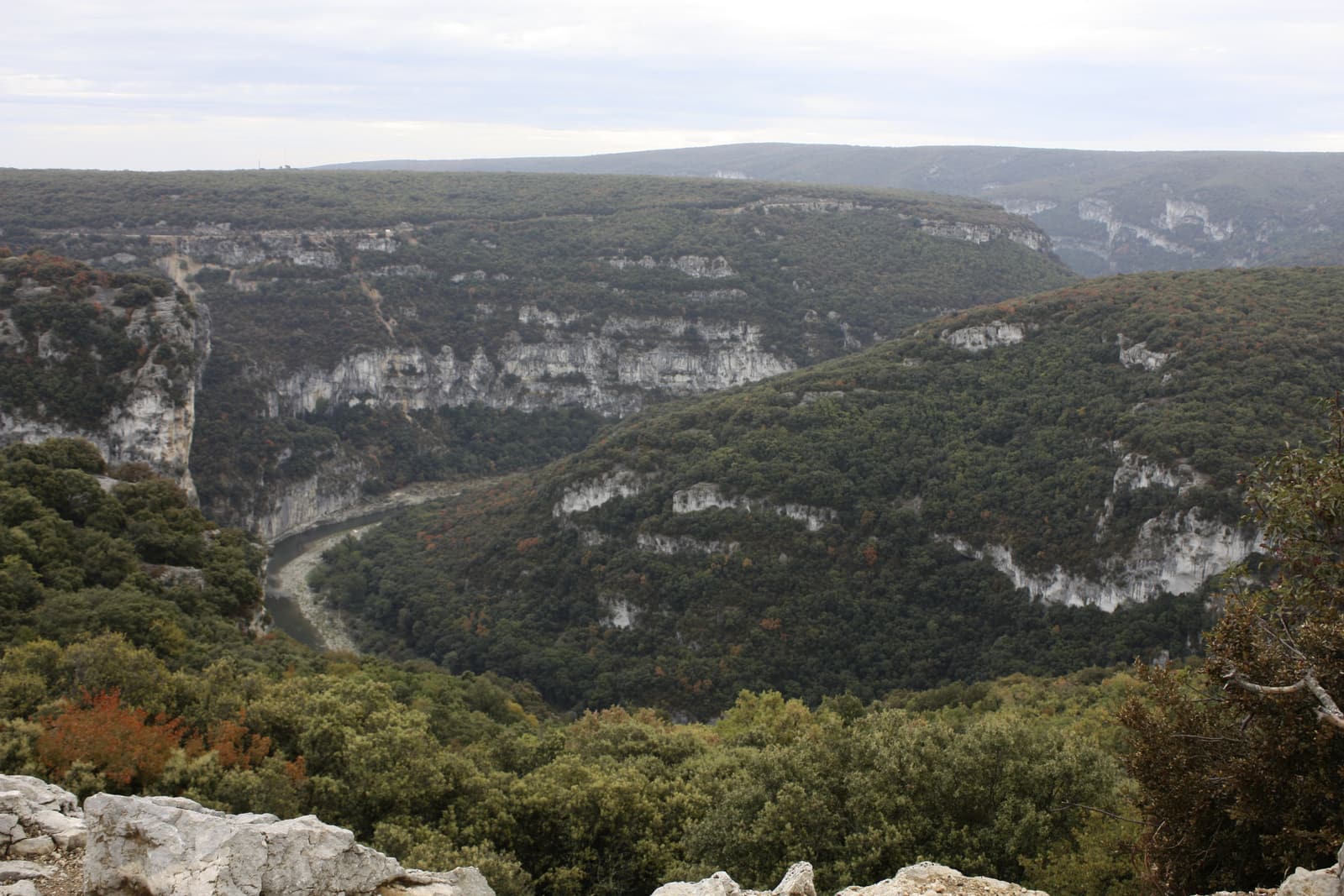
The Gorges de l’Ardèche are a canyon about thirty kilometres long, carved by the river Ardèche through the limestone between Vallon-Pont-d’Arc and Saint-Martin-d’Ardèche, in the south of France. They begin with one of the most famous sights in the country, the natural arch of the Pont d’Arc, and end where the river opens out towards the Rhône beneath the fortified village of Aiguèze.
Between the two, the river loops through deep meanders under cliffs that rise as much as a few hundred metres. Most of the canyon is a national nature reserve with no road along the bottom: you explore it by canoe or on foot, or look down into it from the belvederes of the Route des Gorges on the rim.
A short history
People have lived around the gorges for a very long time. The Chauvet cave, discovered in 1994 near the Pont d’Arc, holds paintings and engravings of animals made more than 30,000 years ago — among the oldest known figurative art in the world. The plateaus are scattered with dolmens from much later prehistoric periods. In the Middle Ages, fortified villages such as Aiguèze, Balazuc and Vogüé grew up on the cliffs above the river.
Modern tourism took off with the canoe. Today the gorges draw large numbers of visitors every summer, and the Réserve naturelle nationale des Gorges de l’Ardèche, created in 1980, works to keep the canyon wild under that pressure.
The highlights
- The Pont d’Arc — the great natural arch, best seen from a canoe.
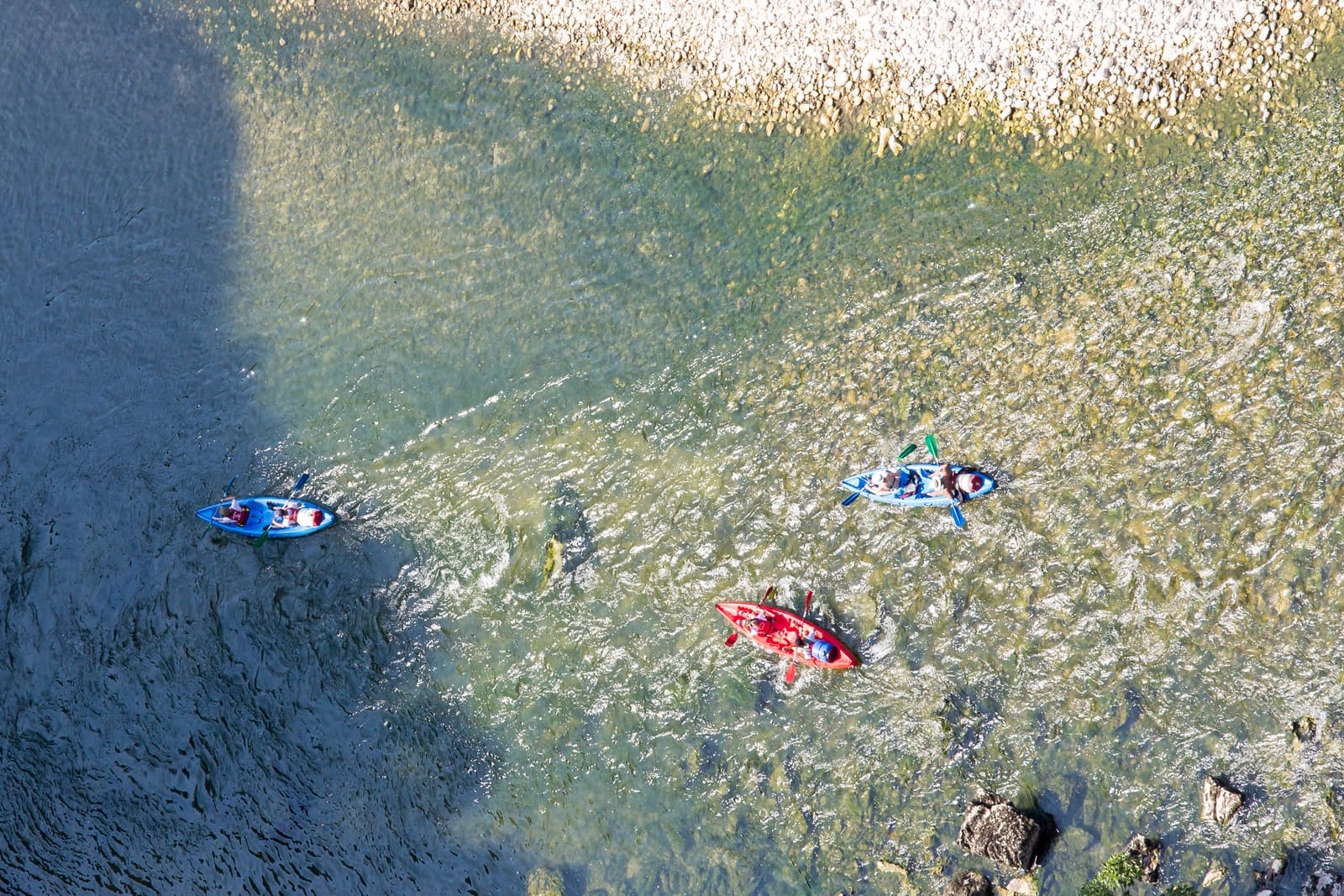
- A canoe descent — two hours, a half-day, a full day or two days with a bivouac.
- The Route des Gorges — the cliff-top drive and its belvederes.
- Grotte Chauvet 2 — the replica of the world’s most famous decorated cave.
- The show caves — Aven d’Orgnac, the Madeleine and Marzal.
- The villages — Aiguèze, Balazuc, Vogüé and Labeaume.
How long to stay
Two days is the minimum to paddle under the Pont d’Arc, drive the Route des Gorges and visit Chauvet 2. Three to four days let you add a village and a second cave at a relaxed pace. A week allows the full descent or a bivouac night, lazy days at the river beaches and some walking.
The table suggests how to spend three days.
| Day | Morning | Afternoon | Evening |
|---|---|---|---|
| 1 | Canoe descent of 6–13 km under the Pont d’Arc | Grotte Chauvet 2 (timed ticket) | Dinner in Vallon-Pont-d’Arc |
| 2 | Route des Gorges belvederes in the early light | Grotte de la Madeleine or Aven Marzal; swim at Sauze | Sunset in Aiguèze |
| 3 | Balazuc and Vogüé | River beach and lunch in Labeaume | Wine tasting or a quiet night |
 The river and the gorges
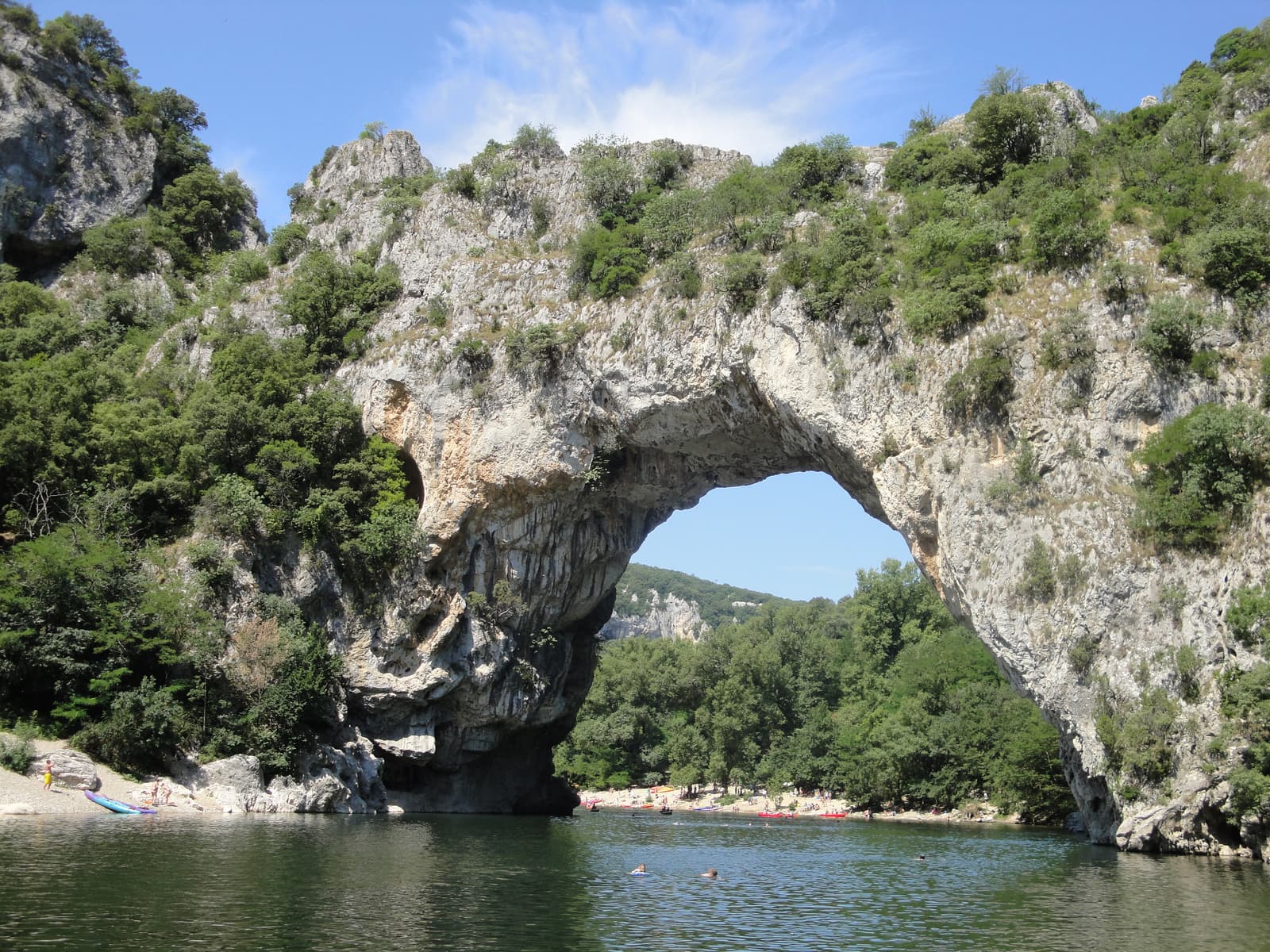
Pont d’Arc
The great natural stone arch that the river flows through — the emblem of the Ardèche.
A natural limestone arch roughly 54 metres high spanning the river Ardèche a few kilometres downstream of Vallon-Pont-d’Arc. You can see it from the road, swim beneath it from the pebble beaches, or — best of all — paddle through it in a canoe.
 The river and the gorges
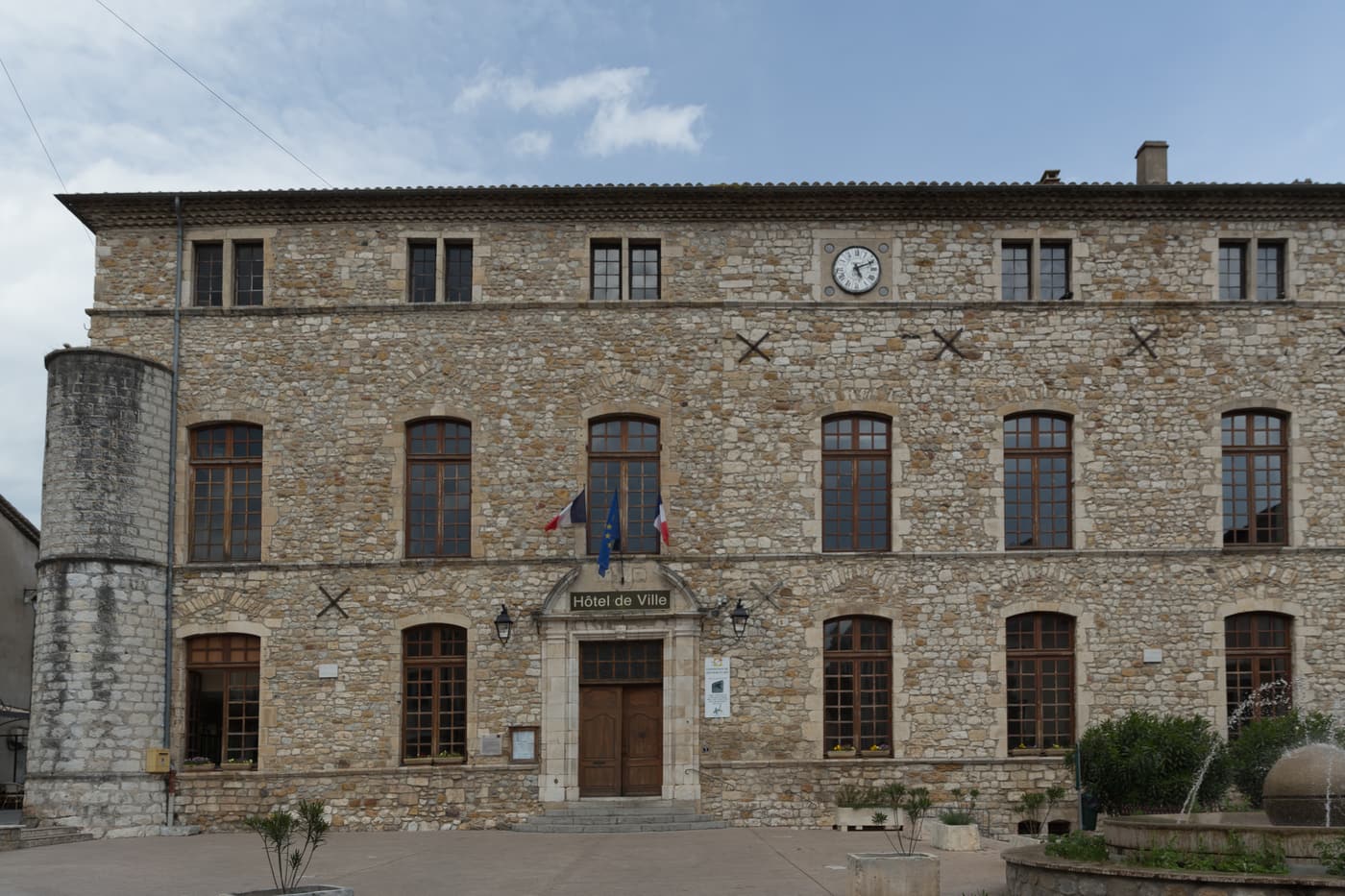
Vallon-Pont-d’Arc
The small town at the top of the gorges — canoe hire, campsites, cafés and the gateway to everything.
The main base for the Gorges de l’Ardèche: a small market town with dozens of canoe-hire companies, the start of the Route des Gorges, Grotte Chauvet 2 on the plateau above and most of the area’s hotels and campsites within a few kilometres.
 The river and the gorges
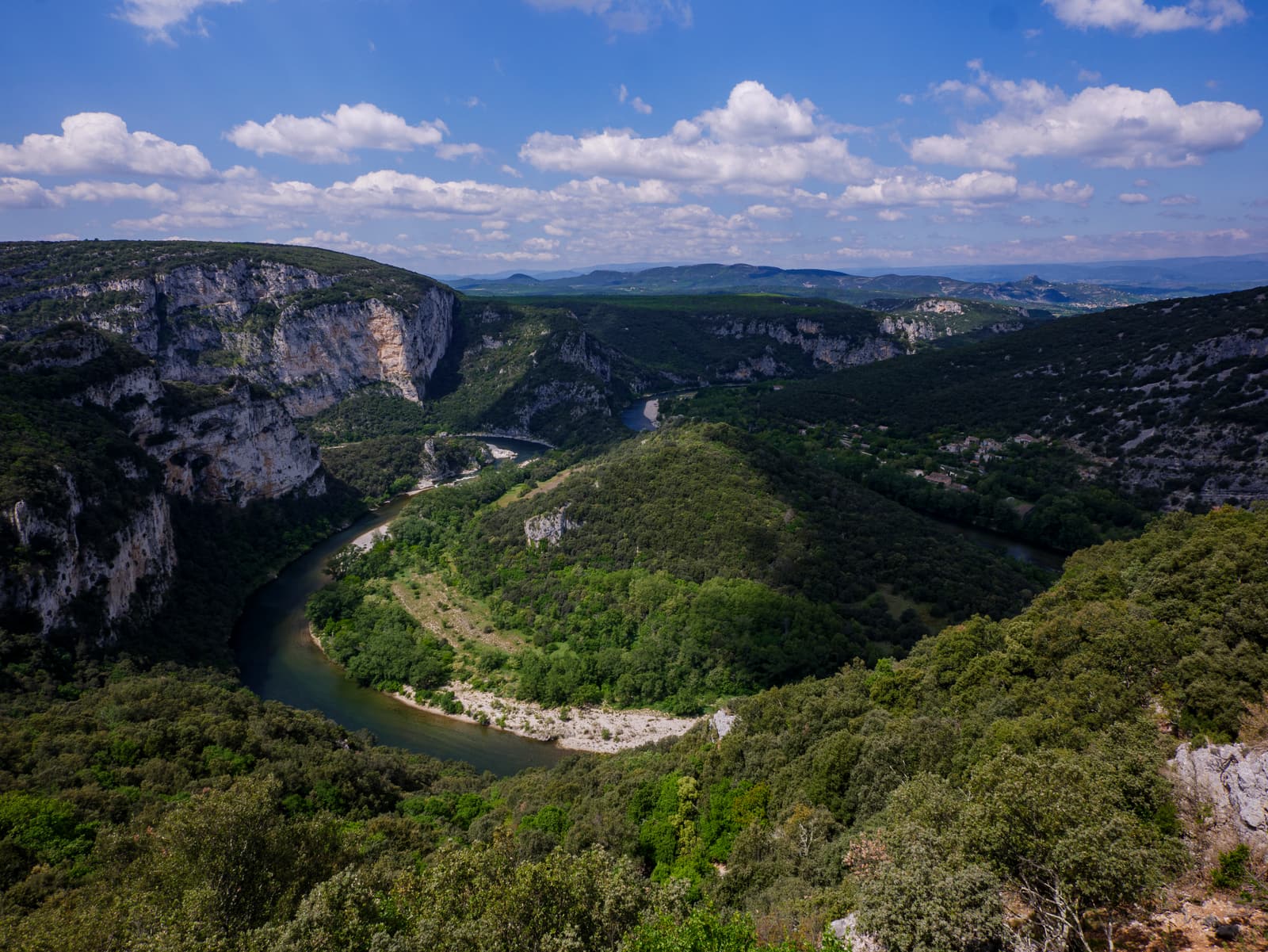
Route des Gorges & belvederes
The cliff-top road along the canyon, with a string of breathtaking viewpoints.
The D290 follows the northern rim of the canyon from Vallon-Pont-d’Arc towards Saint-Martin-d’Ardèche, with around a dozen signposted belvederes — Serre de Tourre, Gaud, Autridge, Gournier, la Madeleine, the Templiers and more — looking straight down onto the river’s meanders.
 Caves and prehistory
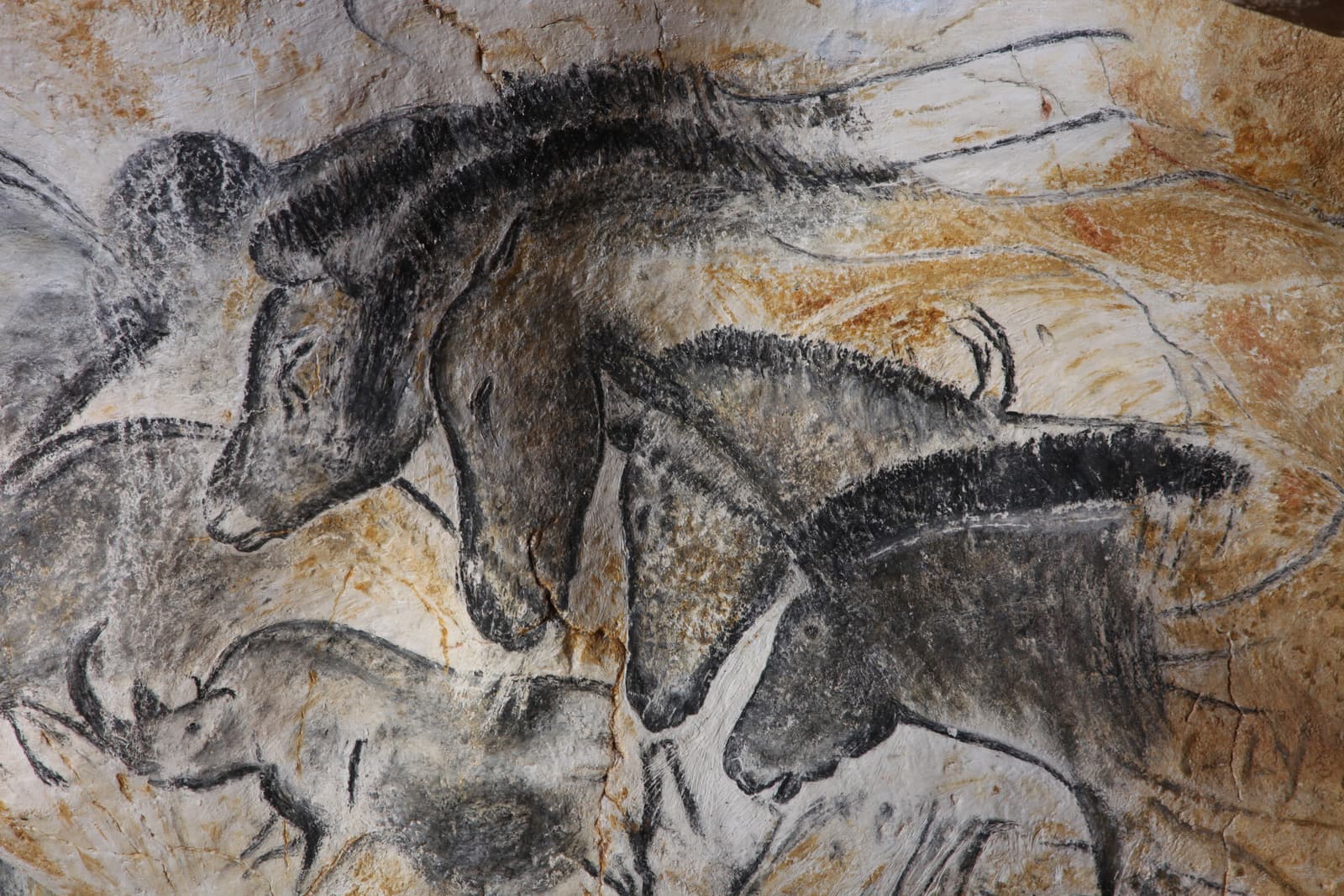
Grotte Chauvet 2
The replica of the world-famous decorated cave — some of the oldest known paintings on earth.
The original Chauvet cave, discovered in 1994 in the cliffs near the Pont d’Arc and a UNESCO World Heritage Site since 2014, is sealed to protect its paintings of lions, horses, rhinos and bears made more than 30,000 years ago. Grotte Chauvet 2, on the plateau above Vallon, recreates it at full scale.
A week in the gorges
Spread the three days above over a week and add: the two-day descent with a night at the Gaud or Gournier bivouac (or the full 32 km in a day), the Aven d’Orgnac and its prehistory museum, an e-bike wine tour, a hike on the plateau, and at least one day doing very little on a river beach.
Practical information
- Money: the euro. Cards are accepted almost everywhere; carry some cash for markets and small snack bars.
- Language: French. Staff at canoe bases, campsites and the main sites are used to visitors, and many speak some English, Dutch or German, but a few words of French go a long way.
- Tourist offices: in Vallon-Pont-d’Arc, Saint-Martin-d’Ardèche and other towns — the place for bivouac bookings, maps, current rules and shuttle information.
- Mobile signal: patchy or absent at the bottom of the gorges. Tell someone your plans before a long descent or hike.
- Emergency number: 112 across the EU.
Heat, water and fire
Summer in the south Ardèche is hot, often well above 30°C, and the limestone reflects the heat. Drink far more water than you think, avoid walking in the middle of the day and use the caves as cool refuges. In periods of high fire risk, access to some forest areas and trails can be restricted, and barbecues and fires are forbidden — respect the signs. After heavy rain, especially in autumn, the river can rise very fast; never camp or picnic on a gravel bar if storms are forecast upstream.
Food and wine
Ardèche cooking is generous and rural: chestnuts in every form (the Ardèche is famous for them), caillettes (a pork-and-greens terrine), charcuterie, picodon goat’s cheese, and honey from the garrigue. The local wines are mostly from the Ardèche IGP and Côtes du Vivarais vineyards around the gorges — tastings and e-bike vineyard tours are easy to book.
What to pack
- Water shoes or old trainers for the river and the pebble beaches.
- Hat, sunglasses, high-factor sun cream and a refillable water bottle.
- A light jumper for the caves, which are cool all year.
- Walking shoes with grip for the trails and village lanes.
- A small dry bag for your phone on the water.
Responsible travel
The gorges are protected for good reason. Stay on paths, take all rubbish home, do not build cairns or move stones in the river, keep noise down at the bivouacs, and respect the reserve’s rules on camping and fires. Avoiding the busiest hours in July and August helps you and the canyon.
Combine your trip
Heading south, the Camargue is roughly one and a half to two hours’ drive from the downstream end of the gorges, via Avignon or Nîmes — a flat world of lagoons, flamingos, white horses and black bulls after the cliffs of the Ardèche. Our Camargue travel guide explains the delta, its traditions and the practical details of a visit.
Marseille, about two and a half hours from Vallon-Pont-d’Arc by car, makes a good last stop if you fly home from Marseille Provence. Boats from its Vieux-Port cross to the island prison made famous by The Count of Monte Cristo; our guide to visiting the Château d’If covers tickets, timing and the boat.