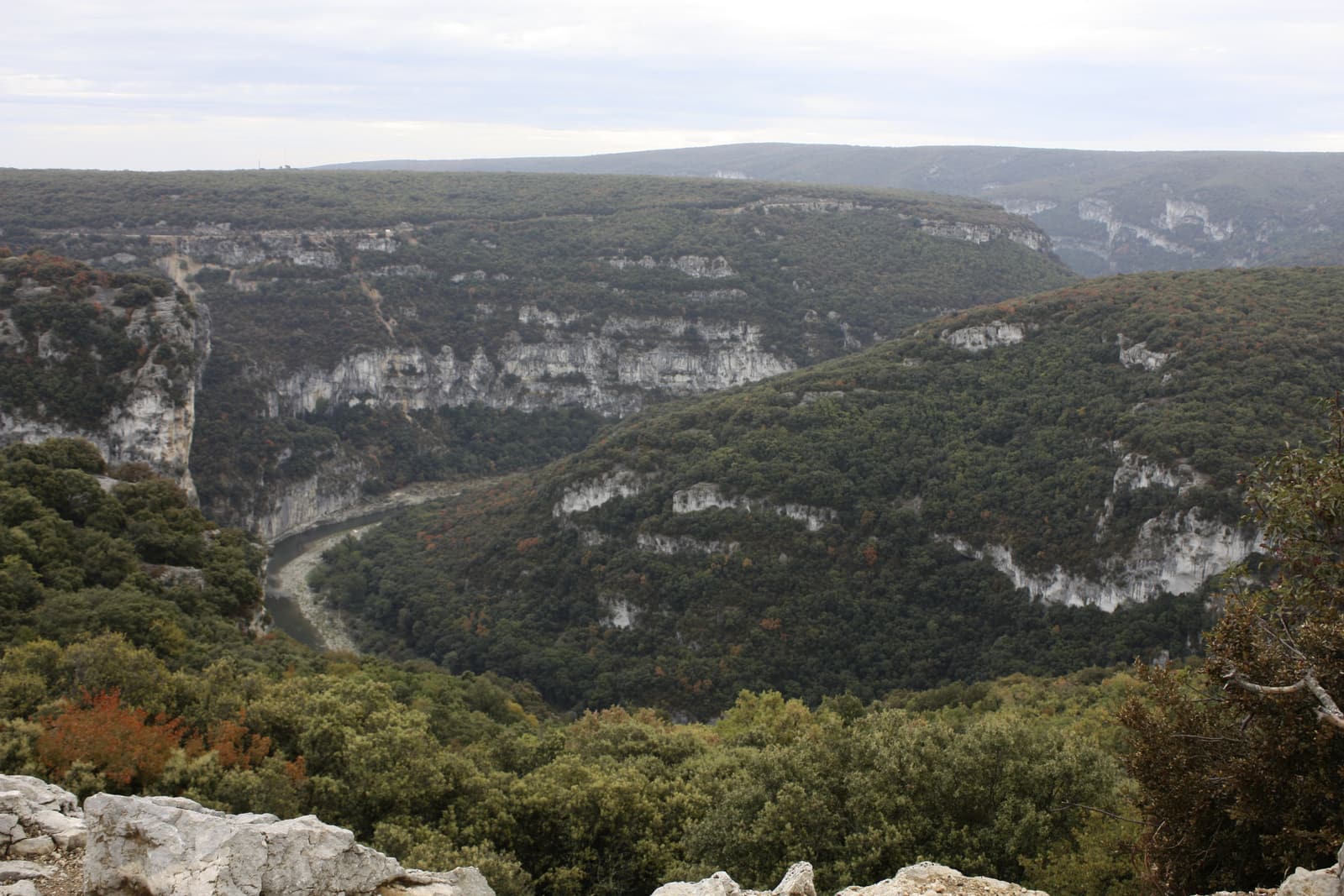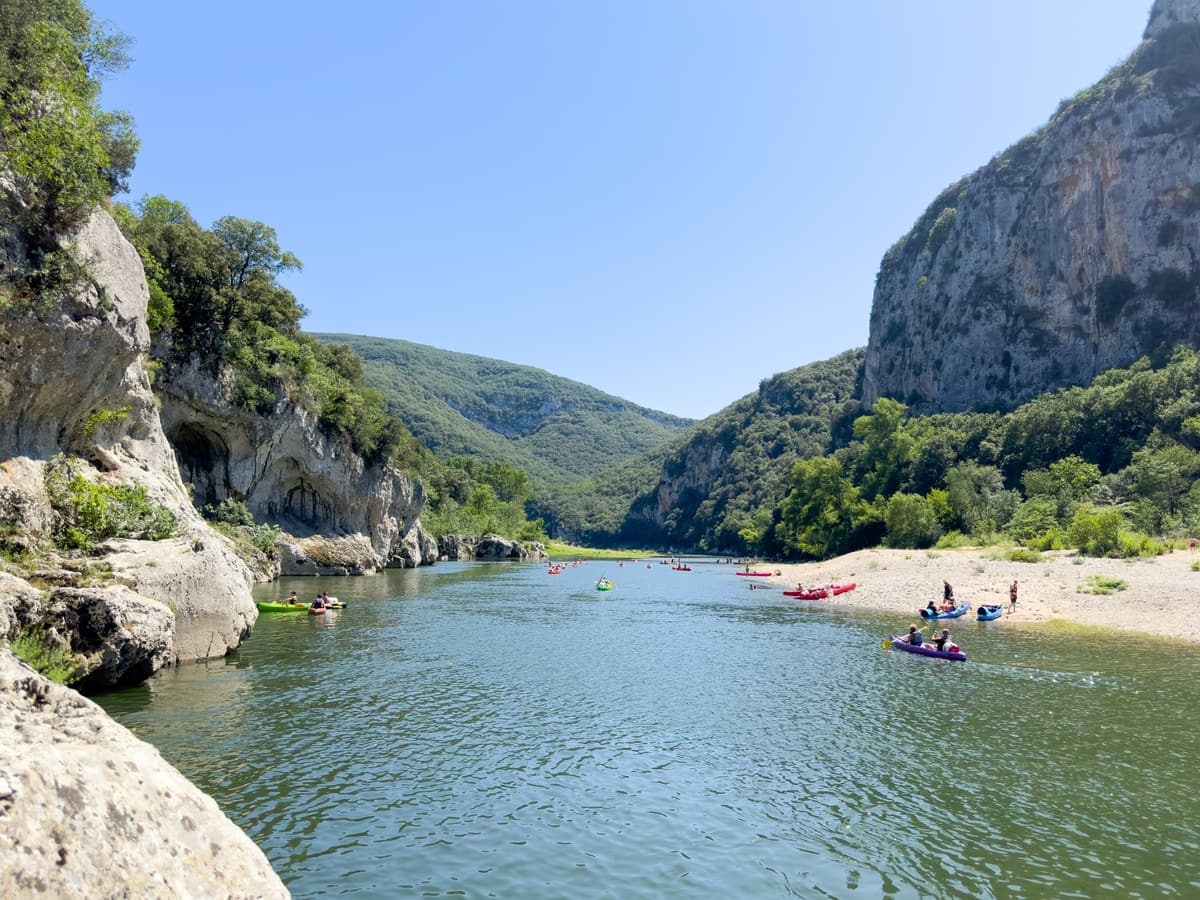
Canoeing the Ardèche is one of the great outdoor experiences in France, and one of the most accessible. You do not need any experience for the short descents: the river is mostly calm, broken by small rapids, and the route is impossible to get lost on. But the long descents are serious days in the sun, and the river is a living thing whose level changes with the seasons and the storms.
How it works
Dozens of canoe-hire companies operate from Vallon-Pont-d’Arc and Salavas, on opposite banks of the river at the top of the gorges. You choose a distance, arrive at the base, receive life jackets, paddles, a canoe (usually for two or three people) or a kayak, and waterproof containers for your things. After a short briefing you put in and paddle downstream at your own pace. At the end of the route a company bus brings you, and the boat, back to the base.
The short routes end above or around the Pont d’Arc area; the long ones run all the way through the gorges to Sauze, near Saint-Martin-d’Ardèche. You can book directly with a company, or online with free cancellation on many options through our activities page.
The routes, by distance
Exact distances vary slightly between companies, depending on where their bases and pick-up points are. The table gives the typical options.
| Route | Paddling time | What you see | Best for |
|---|---|---|---|
| Mini descent, ≈6–8 km | ≈2 hours | First rapids, the Pont d’Arc, beaches | Young families, beginners, half-days |
| Family descent, ≈12–13 km | ≈3–4 hours | The Pont d’Arc, rapids, the first cliffs and meanders | Most families and groups |
| Nature reserve, ≈24 km | ≈5–6 hours | The wild heart of the canyon, Gaud, the Madeleine | Fit adults and older teenagers |
| Full descent, ≈32 km in a day | ≈6–8 hours | The whole canyon from Vallon to Sauze | Experienced, fit paddlers |
| Full descent in 2 days, ≈32 km | 2 days with a bivouac night | The whole canyon, evening and morning in the reserve | Anyone fit who wants the best experience |
The two-day descent and the bivouacs
The best way to see the gorges is to take two days and sleep in the nature reserve. Inside the reserve, overnight stays are allowed only at two bivouac sites, Gaud and Gournier, and booking is compulsory. You book online through the official gorges bivouac service or at a local tourist office, and rent the tent at the same time (three-, six- and fifteen-person tents are offered).
The bivouacs have toilets, showers, sinks, drinking water, shared grills and picnic tables, but no electric sockets. Fires are forbidden; you cook on the shared grills or on your own camping stove. Everything you bring must fit in the waterproof container supplied by your canoe company — the official advice is around 55 litres per person — so pack light and freeze any meat. You must arrive by 8 p.m. at the latest, which is when navigation in the reserve ends. Dogs are not allowed on the canoe trips. Rules and season dates can change: check the official site when you book.
The rapids
The Ardèche is not white water in the extreme sense: in summer its rapids are short, shallow riffles and chutes between calm pools. The best known have names — paddlers talk about the Charlemagne rapid just before the Pont d’Arc, and the Dent Noire further down — and they are where most capsizes happen. Keep to the main current, keep the boat straight, and if you go in, hold on to the canoe and float feet first downstream. In some places you can walk round a rapid on the bank.
Water levels and the season
Most canoe companies operate from around April to September, with some extending into October. In spring the river is higher, colder and faster; in July and August it is low, warm and slow, and on the shallowest stretches you may have to step out and pull the boat. After heavy rain, particularly the violent autumn storms of the Cévennes, the river can rise very quickly; the authorities can restrict navigation and companies will not rent boats when the water is too high. Always follow the company’s advice on the day.
Rules, ages and safety
- Life jackets are provided and must be worn, fastened, at all times.
- You must be able to swim. Companies set their own minimum age; for short descents, children from around 7 who can swim are commonly accepted.
- Inside the reserve: no camping outside the bivouacs, no fires, take all rubbish out, and finish navigating by 8 p.m.
- Alcohol and the sun cause more trouble than the rapids. Drink plenty of water, wear a hat and sun cream, and do not paddle drunk.
- Respect swimmers and other boats, especially around the Pont d’Arc.
What to bring
- Shoes that can get wet and stay on your feet (no flip-flops).
- Hat, sunglasses with a strap, high-factor sun cream and a long-sleeved top.
- Plenty of water and a picnic — on the long descents there is almost nothing to buy.
- A dry change of clothes left in the car or in the waterproof container.
- Keys, phone and money in the sealed container; the company will usually advise you on what not to take.
Other ways onto the water
Prefer someone else in charge? Some companies offer guided descents. For a different river, try the guided kayak and mountain-bike day on the Chassezac, or the canyoning trip with zip-lines in the north of the department. And for a day off, the river beaches at the Pont d’Arc, Sauze and Balazuc are perfect for a swim.